Try it free

For parents: a nature scavenger hunt you can actually do today

What can your kid find outside? A backyard nature scavenger hunt

You don't need a forest or a free Saturday. Most kids can find ten wild things within a block of home: a squirrel, a few birds at a feeder, a spider web on the porch, a patch of clover, maybe a frog calling after rain.

This guide is built for kids about 5 to 12 and the grown-up walking with them. Pick a few finds below, head out for 20 minutes, and turn it into a photo scavenger hunt. Each find your kid photographs and identifies becomes a card in their Dex, so the hunt keeps going on the next walk.

How to run a 20-minute photo scavenger hunt

  1. Pick a small zone: the yard, the block, or one path at the park.
  2. Choose five finds from this page, or print the checklist. Mix easy ones (a squirrel, clover) with one stretch find.
  3. Set a timer for 20 minutes. Kids lead and grown-ups carry the phone or let older kids hold it.
  4. Spot it, then snap it. Get close enough for a clear photo, but never touch wild animals.
  5. Back home, check off what you found and talk about the one that got away. That's next week's target.

Pick a hunt

Backyard birds

Birds kids can spot at a feeder, on a wire or at the beach.

Bug hunt: bugs and spiders

Bugs and spiders for a backyard bug hunt, and which ones are safe.

Plants, flowers and mushrooms

Flowers, leaves and mushrooms, plus what never to eat.

Frogs, lizards and pond life

Frogs, lizards, turtles and pond life on warm days and rainy nights.

Backyard mammals and animal tracks

Mammals are shy, so they make great stretch finds. Many are easiest to spot at dawn and dusk, and their tracks in mud or snow count as a clue even when the animal is long gone.

Eastern Fox Squirrel

Sciurus niger

How to recognize it
A big tree squirrel with a rusty orange belly and a bushy tail edged in orange.
Where and when
Oak trees, yards, parks and fence tops. Busiest in the morning and late afternoon, all year.
Lookalike
Eastern gray squirrel: gray back and a white belly, not orange.

Snap it for your Dex: Wait for it to pause on a trunk so the orange belly shows, then snap.
Desert Cottontail

Sylvilagus audubonii

How to recognize it
A small tan rabbit with big ears, long legs and a white cotton-ball tail.
Where and when
Dry brushy yards, parks and desert edges in the West and Southwest. Look at dawn and dusk.
Lookalike
Black-tailed jackrabbit: much bigger, with very long black-tipped ears.

Snap it for your Dex: Rabbits freeze before they run. Stop walking, zoom in and snap while it holds still.

Virginia Opossum

Didelphis virginiana

How to recognize it
Gray shaggy fur, a white pointed face, a pink nose and a long bare tail.
Where and when
At night, all year: along fences, under decks and near trash cans.
Lookalike
A big rat: much smaller, with a brown face instead of a white one.
Safety
Opossums are not aggressive, but never touch a wild animal.

Snap it for your Dex: Snap from a porch or window with the porch light on. Never corner one.

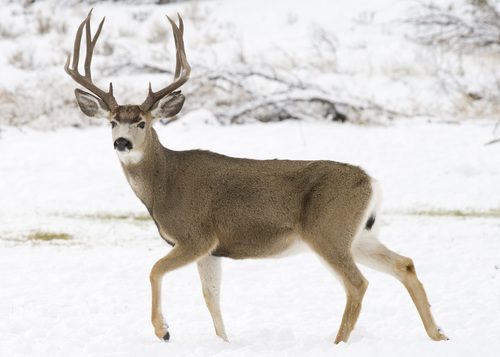
Mule Deer (Odocoileus hemionus)
Photo: Oregon Department of Fish & Wildlife, CC BY-SA · source

Mule Deer

Odocoileus hemionus

How to recognize it
A big gray-brown deer with huge, mule-like ears and a white rump with a black-tipped tail.
Where and when
Western foothills, parks and forest edges, at dawn and dusk in any season.
Lookalike
White-tailed deer: smaller ears and a wide tail that flashes white underneath when it runs.
Safety
Stay far back from deer, and never get between a mother and her fawn.

Snap it for your Dex: Snap from the car or the trail and give it lots of room, especially bucks in fall.

California Ground Squirrel

Otospermophilus beecheyi

How to recognize it
A speckled gray-brown squirrel with a pale collar that pops in and out of burrows.
Where and when
Open grassy hills, parks, picnic areas and roadsides in California and Oregon, on sunny days.
Lookalike
Tree squirrels: plain backs, and they escape up a tree instead of down a hole.
Safety
Do not feed them or reach into burrows.

Snap it for your Dex: Sit near a burrow and wait a few minutes. They come back out to look around.

Muskrat

Ondatra zibethicus

How to recognize it
A chunky brown swimmer with a skinny, flat tail it uses like a rudder.
Where and when
Ponds, marshes and slow creeks at dawn and dusk. Look for V-shaped ripples and dome-shaped plant lodges.
Lookalike
Beaver: much bigger, with a wide, flat paddle tail.

Snap it for your Dex: Watch the water edge quietly. If it dives, wait for it to pop up a few feet away.

Bobcat

Lynx rufus

How to recognize it
A short-tailed wild cat about twice the size of a house cat, with spotted fur and black tufts on its ears.
Where and when
Where do bobcats live? In most of the lower 48 states, in forests, swamps, deserts, farm edges and even the edge of suburbs. They are shy and come out mostly at dawn, dusk and night.
Lookalike
A big house cat: long tail. A bobcat's tail is short, like it was bobbed.
Safety
Never approach a bobcat. Enjoy it from a distance.

Snap it for your Dex: This is the rare find. If you ever see one, snap it from far away. Round tracks in mud with no claw marks are a fun clue to look for.

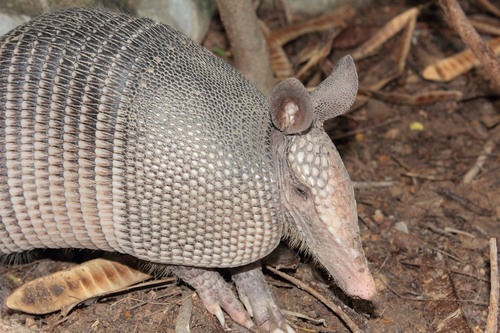
Mexican Long-nosed Armadillo (Dasypus mexicanus)
Photo: Juan Cruzado Cortés, CC BY-SA · source

Mexican Long-nosed Armadillo

Dasypus mexicanus

How to recognize it
A small armored mammal with a long snout, a banded shell and a long scaly tail.
Where and when
Texas, the Gulf states and the Southeast, at dusk and night, digging for bugs in lawns and brush.
Lookalike
Nothing else in the US has a shell like this. In Texas it is the armadillo most people mean.
Safety
Look, snap and let it go. Never pick one up.

Snap it for your Dex: Snap it while it sniffs the ground. It may jump straight up if startled.

Make it a scavenger hunt

Print the free checklist with every find on this page, hand it to your kid with a pencil, and set a timer. Check off each one you spot. Or play it in the app: Spot it, Snap it, Collect it. Every photo becomes a verified card in your kid's Dex.

Or play it in the app

Bigger finds on park trips

Save these for state and national parks. Always use zoom and stay far back: at least 25 yards from bison and elk, and at least 100 yards from bears.

Park trip finds

FindWhere to lookWhen
American BisonBison bisonVisit national parks like Yellowstone or wildlife refuges.Stay at least 25 yards away.Any time of day, year-round; best viewing in morning or late afternoon
American Black BearUrsus americanusLook for tracks in mud or snow near berry bushes.Stay at least 100 yards away.Dawn and dusk, during spring, summer, and fall
WapitiCervus canadensisLook for them in open meadows at dawn or dusk, or listen for their bugling calls during the fall mating season.Stay at least 25 yards away.Dawn and dusk are best for spotting them, especially in spring, summer, and fall
Common Golden-mantled Ground SquirrelCallospermophilus lateralisLook for them scampering over rocks and logs.Daytime, spring through fall (they hibernate in winter)

What to look for each season

Fall

Woolly bear caterpillars crossing sidewalks, goldenrod in bloom, orbweaver webs on porches, and juncos and sparrows arriving at feeders as birds migrate.

Winter

Animal tracks in mud or snow, great horned owls hooting at dusk, evergreen ferns and redcedars, and busy feeders.

Spring

Frogs calling after rain, redbud and mayapple flowers, nesting barn swallows, and the first butterflies.

Summer

Dragonflies at ponds, lizards on fences, bumble bees on clover, sunflowers, and treefrogs at the porch light.

Stay safe on a wildlife hunt

  • Look and snap, never touch. Wild animals can bite, scratch or carry germs.
  • Never feed wildlife, and never get between a mother animal and her babies.
  • An animal that seems tame or sick during the day should be left alone. Tell a grown-up.
  • Stay on paths in parks, and keep the distances above for big animals.

Why kids keep going

Spot, Snap, Collect

Kids find something real outside and photograph it. That's the whole game, and it only works outdoors.

Every card is verified

HabitatLab checks each photo and identifies the species, so every card in the Dex is a real find your kid made, not a guess.

You see what they learned

The Grown-Up Field Report shows you what your kid found, the science behind it, and questions worth asking at dinner.

Questions parents ask

What should be on a nature scavenger hunt for kids?

Mix easy, sure finds with one or two harder ones. A good backyard list: a squirrel, two different birds, a spider web, a butterfly or bee, a clover or dandelion, a tree leaf you can name, and one stretch find like a frog, a hawk or animal tracks.

Is there a nature scavenger hunt app for kids?

Yes. HabitatLab turns a nature scavenger hunt into a photo game: kids spot something, snap it, and the app identifies it. Each verified find becomes a card in their Dex. You can try it free.

What animals live in my backyard?

In most of the US: squirrels, rabbits, opossums, raccoons, many birds, and plenty of bugs and spiders. Near water, add frogs, turtles and muskrats. The finds on this page cover the most common ones.

Where do bobcats live?

Bobcats live in most of the lower 48 states, from forests and swamps to deserts and the edges of towns. They are shy and mostly come out at dawn, dusk and night, so a sighting is a real rare find.