Try it free

For parents: backyard bird watching for kids

Backyard birds kids can spot (and how to tell them apart)

Birds are the easiest wild animals for kids to find, because they come to you. A feeder, a lawn, a power line or a pond will do. In 20 minutes most families can spot four or five different birds without leaving the block.

This guide shows the birds kids are most likely to see, how to tell them from their lookalikes in kid words, and when to look. Turn it into a bird scavenger hunt: every bird your kid photographs and identifies becomes a card in their Dex.

Where to look for birds

  1. At a feeder: chickadees, titmice, juncos and sparrows. Sunflower seeds bring the most visitors.
  2. On wires and fence tops: mockingbirds, bluebirds and swallows sit out in the open.
  3. On the lawn: grackles, robins and sparrows walk and hop while they hunt for food.
  4. At water: ponds, beaches and piers bring gulls, pelicans, ducks and herons.
  5. Listen first. Many birds are heard before they're seen. Follow the song, then look.

Start here: 12 backyard birds

These are common, easy to recognize, and found across big parts of the US. Each card has one clue to look for and one lookalike to rule out.

Brown Pelican

Pelecanus occidentalis

How to recognize it
A huge brown-gray seabird with a long bill and a stretchy throat pouch.
Where and when
Ocean coasts, piers, docks and buoys in the Southeast, Gulf and West Coast, any time of day.
Lookalike
American white pelican: all white with black wing tips, and it does not dive.

Snap it for your Dex: Watch for a headfirst dive into the water, then snap it floating or perched on a post.

Northern Mockingbird

Mimus polyglottos

How to recognize it
A slim gray bird with a long tail and flashy white wing patches when it flies.
Where and when
Treetops, rooftops and wires in yards and parks across most of the US, all year.
Lookalike
Gray catbird: darker gray with a black cap and no white wing patches.

Snap it for your Dex: Follow the long song that keeps changing to its high perch.

Carolina Wren

Thryothorus ludovicianus

How to recognize it
A small round rusty-brown bird with a bold white eyebrow and a tail cocked up.
Where and when
Thick shrubs, brush piles and porches in the East and Southeast, all year.
Lookalike
House wren: plainer gray-brown with no bold white eyebrow.

Snap it for your Dex: Follow the loud 'teakettle-teakettle' song to the bush, then wait for it to hop out.

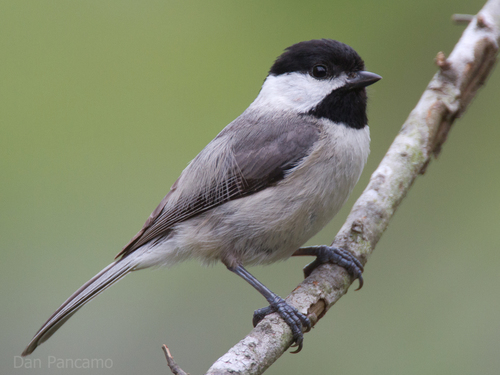
Carolina Chickadee (Poecile carolinensis)
Photo: Dan Pancamo, CC BY-SA · source

Carolina Chickadee

Poecile carolinensis

How to recognize it
A tiny gray bird with a black cap, a black bib and white cheeks.
Where and when
Feeders and leafy trees in the Southeast and Mid-Atlantic, all year.
Lookalike
Black-capped chickadee in the North looks almost the same. Where you live is the best clue.

Snap it for your Dex: Sunflower seeds in a feeder bring them in close for a snap.

Tufted Titmouse

Baeolophus bicolor

How to recognize it
A small gray bird with a pointed crest, big dark eyes and peachy sides.
Where and when
Feeders and leafy trees in the East, all year.
Lookalike
Carolina chickadee: black cap and bib, and no crest.

Snap it for your Dex: Listen for a loud 'peter-peter-peter', then look in the nearest tree.

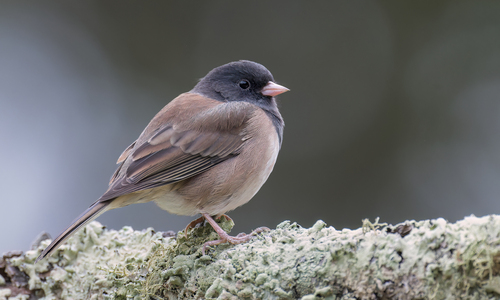
Dark-eyed Junco (Junco hyemalis)
Photo: Becky Matsubara, CC BY · source

Dark-eyed Junco

Junco hyemalis

How to recognize it
A gray or brown bird the size of a sparrow, with a pale pink bill and white outer tail feathers that flash when it flies.
Where and when
On the ground under feeders and bushes. Across most of the US in fall and winter.
Lookalike
Sparrows: streaky brown, without the clean gray hood.

Snap it for your Dex: Fall and winter mornings under a feeder are the best time to snap one.

Song Sparrow

Melospiza melodia

How to recognize it
A streaky brown sparrow with a dark spot in the middle of its chest.
Where and when
Shrubby yards, fields and wet edges across most of the US. Easiest to hear in spring.
Lookalike
Other streaky sparrows: look for that one central chest spot.

Snap it for your Dex: It often sings from the top of a low bush. Snap it mid-song.

Common Grackle

Quiscalus quiscula

How to recognize it
A big glossy black bird with a long tail and pale yellow eyes. Its head shines purple or blue in sun.
Where and when
Lawns, parking lots and fields in the East and Central US, often in noisy flocks.
Lookalike
Red-winged blackbird (red shoulder patches) and European starling (short tail, speckled in winter).

Snap it for your Dex: Snap one walking on a lawn in bright sun to catch the shiny colors.

Barn Swallow

Hirundo rustica

How to recognize it
A fast flier with a deeply forked tail, a blue back and an orange throat.
Where and when
Over fields and water in spring and summer. Nests under bridges, porches and barn roofs.
Lookalike
Tree swallow: white below with a short, notched tail.
Safety
Watch nests from a distance and never touch them.

Snap it for your Dex: They are too fast in the air. Snap them resting on a wire or fence.

Western Bluebird

Sialia mexicana

How to recognize it
A small bird with a bright blue head and wings and a rusty orange chest.
Where and when
Open woods, parks, farms and golf courses in the West. Look on fences and low branches.
Lookalike
Eastern bluebird lives in the East and has an orange throat. The western bluebird male's throat is blue.

Snap it for your Dex: Watch a fence line. It drops to the grass for a bug and flies back to the same perch.

Great Horned Owl

Bubo virginianus

How to recognize it
A big owl with feather 'horns' (ear tufts), yellow eyes and a white throat patch.
Where and when
Woods, parks and even city neighborhoods across the US. Listen at dusk, especially in winter.
Lookalike
Barred owl: a round head with no ear tufts and dark eyes.
Safety
Never go close to an owl nest.

Snap it for your Dex: Owls are hard to snap. Look for a big shape in a tree at dusk and snap from far away.

Cooper's Hawk

Astur cooperii

How to recognize it
A crow-sized hawk with short rounded wings, a long banded tail and red-orange eyes as an adult.
Where and when
Backyards near feeders, all year in much of the US. If the feeder birds suddenly vanish, look up.
Lookalike
Sharp-shinned hawk: smaller with a square tail tip. Even experts mix these two up.

Snap it for your Dex: It often sits still on a branch after a chase. That is your chance.

Make it a scavenger hunt

Print the free checklist with every find on this page, hand it to your kid with a pencil, and set a timer. Check off each one you spot. Or play it in the app: Spot it, Snap it, Collect it. Every photo becomes a verified card in your kid's Dex.

Or play it in the app

Full bird checklist

More birds to add to the hunt, with where to look and when.

Beach and pond birds

FindWhere to lookWhen
American Herring GullLarus smithsonianusLook for them soaring gracefully over water, perching on lampposts, or walking confidently on beaches and in parking lots.Year-round
Ring-billed GullLarus delawarensisLook for medium-sized gulls with a yellow bill that has a black ring.Daytime, year-round in many parts of the US
Laughing GullLeucophaeus atricillaLook for them near the water, often flying low or walking along the sand.Daytime, especially during breeding season (spring and summer) to see their dark heads
Western GullLarus occidentalisLook for large gulls with dark gray backs, white heads and undersides, and pink legs.All day, any time of year along the Pacific coast
WilletTringa semipalmataLook for them wading in shallow water or running along beaches.Daytime, especially during low tide when more food is exposed
White IbisEudocimus albusLook for groups of these white birds wading in shallow water.Daytime, especially in the morning and late afternoon
Double-crested CormorantNannopterum auritumLook for them swimming low in the water, sometimes diving completely under.Daytime, especially morning and late afternoon when they are actively fishing or drying wings
BuffleheadBucephala albeolaLook for small ducks that dive under water frequently.Daytime, during fall, winter, and spring in migration or wintering areas
Pied-billed GrebePodilymbus podicepsLook for a small, brownish bird that sits low in the water.Daytime, year-round, at dawn and dusk for best activity
Northern ShovelerSpatula clypeataLook for a duck with a very long, wide, spoon-shaped bill.Daytime, during fall and spring migration or in wintering areas
Black-crowned Night HeronNycticorax nycticoraxLook for them resting quietly during the day in trees or dense bushes near water.Dusk and nighttime are when they are most active

Yard, field and sky birds

FindWhere to lookWhen
Chipping SparrowSpizella passerinaListen for their distinctive, rapid 'chip-chip-chip' song, which sounds like someone tapping two pebbles together.Early morning and late afternoon, especially during breeding season
White-crowned SparrowZonotrichia leucophrysLook for a medium-sized sparrow with a distinct black and white striped crown on its head.Fall and spring during migration, and winter in many parts of the US
White-throated SparrowZonotrichia albicollisLook on the ground under feeders or in dense shrubbery.Daytime, especially early morning
Brown-headed CowbirdMolothrus aterLook for a chunky, short-tailed black bird with a brown head (males) or an all grayish-brown bird (females), often foraging on the ground.Daytime, especially morning and late afternoon
Great-tailed GrackleQuiscalus mexicanusLook for them in parking lots, parks, and fields, often walking on the ground.All day, year-round
Yellow-rumped WarblerSetophaga coronataLook for small, active birds in trees and bushes.Fall and spring during migration, but you can see them in many places in winter too
Ruby-crowned KingletCorthylio calendulaLook for a very active, tiny bird constantly flicking its wings.Spring and fall during migration; listen for their songs in the morning
Common RavenCorvus coraxLook for large black birds soaring or perched high up.All year round, during the day
Black VultureCoragyps atratusLook up in the sky for their distinctive soaring pattern: they often hold their wings in a 'V' shape and wobble a bit.Daytime, especially when the sun is out and thermals are strong
Red-shouldered HawkButeo lineatusListen for their distinctive 'kee-aahh' call, especially in spring.Daytime, particularly in the morning or late afternoon
Barred OwlStrix variaListen for their distinctive 'Who cooks for you?' call, especially at dusk or dawn.Dusk and dawn, or moonlit nights

Bird safety for kids

  • Never touch nests, eggs or baby birds. Watch from a distance.
  • A baby bird hopping on the ground with feathers is usually fine. Its parents are close by, so leave it alone.
  • Don't chase birds or flush them on purpose. Let them come to you.
  • Wash your hands after filling or cleaning a bird feeder.

Why kids keep going

Spot, Snap, Collect

Kids find something real outside and photograph it. That's the whole game, and it only works outdoors.

Every card is verified

HabitatLab checks each photo and identifies the species, so every card in the Dex is a real find your kid made, not a guess.

You see what they learned

The Grown-Up Field Report shows you what your kid found, the science behind it, and questions worth asking at dinner.

Questions parents ask

What are the easiest backyard birds for kids to identify?

Start with birds that look like nothing else: the northern mockingbird (white wing patches), the tufted titmouse (crest), the dark-eyed junco (white tail flashes), and the common grackle (long tail and yellow eyes).

How do I start bird watching with my kid?

Put out one feeder with sunflower seeds near a window, then spend ten minutes watching together. Name one bird at a time. Kids remember birds they find themselves far better than birds from a book.

Is there a bird identification app for kids?

HabitatLab lets kids photograph a bird and identifies it for them. Every verified bird becomes a card in their Dex, so building a bird collection becomes the game.

How do you make a bird scavenger hunt?

Pick six birds from this page that live where you do, print the checklist, and give kids 20 minutes. Award a bonus for a bird heard but not seen, or for a bird doing something, like eating or singing.